Let's see, the four main officers of state are: Prime Minister, Chancellor, Foreign Secretary and Home Secretary.
So Cameron spoke, Osborne spoke, Hague spoke, and ...where is Grayling? Oops.
Not really a vote of confidence in his home affairs spokes man, eh?
Tuesday, 13 April 2010


Sunday, 11 April 2010
Look After Our NHS
Yesterday I went on the Protect Our Public Services march in central London. Here are some photos from the march and rally.


Thursday, 8 April 2010
National Service
The Labour party pledges apprenticeship places for all 16 and 17 year olds who want it, and a guarantee of a job, training or work experience for every young person aged 18-24.
What do the Tories pledge? The return of National Service. Now they want to take us back to the 50s!

John Rentoul spells out very well the problem with this plan.
It is not just the £800m price tag; there is something dated and illiberal about the idea that the entire nation's cohort of 16-year-olds should be told what to do by the post-bureaucratic bureaucracy for three weeks of their summer holidays.
If you are a 16 year old which party would you want to win: a party who is pledging to give 16-year-olds the vote, or a party who is pledging to force you to do three weeks of National service during your summer holidays? Or, more pertinent to this election, if you are a sympathetic 18-year-old who would you vote for?
I think we can assign cameron's National Service to the bin of "unworkable policies".
What do the Tories pledge? The return of National Service. Now they want to take us back to the 50s!

John Rentoul spells out very well the problem with this plan.
It is not just the £800m price tag; there is something dated and illiberal about the idea that the entire nation's cohort of 16-year-olds should be told what to do by the post-bureaucratic bureaucracy for three weeks of their summer holidays.
If you are a 16 year old which party would you want to win: a party who is pledging to give 16-year-olds the vote, or a party who is pledging to force you to do three weeks of National service during your summer holidays? Or, more pertinent to this election, if you are a sympathetic 18-year-old who would you vote for?
I think we can assign cameron's National Service to the bin of "unworkable policies".
NHS Privatisation
George Osborne thinks that the Conservatives' policy on National Insurance will win the the election. It won't. The public know that there has to be tax rises and they see the Conservatives' plan to be exempting employers, while raising other taxes (eg VAT) on the rest of us. The issue that will lose the election for the Conservatives is their plan to start the privatisation of the NHS.
As his justification for their National Insurance policy David Cameron quotes one of his advisers: Sir Peter Gershon. Sir Peter, he says, has identified £12bn efficiency savings which can be used to pay for the NI policy. Many people point out, of course, that if £6bn or so of those "efficiency savings" are used to pay for the services that the NI rise would have paid, then that £6bn will not be used to cut the deficit. Cameron is showing that the Conservative party are the party of tax cuts, not the party of deficit cuts.
However, more concerning is Sir Peter Gershon's place in business: he is the chairman of General Healthcare Group, the largest private sector health firm in the UK. This is not a worry in itself, but it does become a worry when Cameron accepts his advice on the NHS. In a strategy paper, General Healthcare Group says:
the NHS may face a "very severe contraction in its finance with an £8bn-£10bn cut in real terms likely in the three years from 2011". It continues: "Given this lack of funding growth, there will be an increasing role for the private sector, even if NHS efficiencies can offset some of the budget pressure."
As I have mentioned elsewhere on this blog, it is Cameron's plan that the private sector will have a much larger role in providing NHS services, in fact Andrew Lansley intends to force the NHS to hand services over to the private sector under the direction of his super quango, the NHS Board.
Further, the Guardian reports:
The company has also just commissioned a report from the Economist Intelligence Unit that calls for "new thinking on funding and a growing role for the private sector".
When will David Cameron come clean about his plans to privatise the NHS?
As his justification for their National Insurance policy David Cameron quotes one of his advisers: Sir Peter Gershon. Sir Peter, he says, has identified £12bn efficiency savings which can be used to pay for the NI policy. Many people point out, of course, that if £6bn or so of those "efficiency savings" are used to pay for the services that the NI rise would have paid, then that £6bn will not be used to cut the deficit. Cameron is showing that the Conservative party are the party of tax cuts, not the party of deficit cuts.
However, more concerning is Sir Peter Gershon's place in business: he is the chairman of General Healthcare Group, the largest private sector health firm in the UK. This is not a worry in itself, but it does become a worry when Cameron accepts his advice on the NHS. In a strategy paper, General Healthcare Group says:
the NHS may face a "very severe contraction in its finance with an £8bn-£10bn cut in real terms likely in the three years from 2011". It continues: "Given this lack of funding growth, there will be an increasing role for the private sector, even if NHS efficiencies can offset some of the budget pressure."
As I have mentioned elsewhere on this blog, it is Cameron's plan that the private sector will have a much larger role in providing NHS services, in fact Andrew Lansley intends to force the NHS to hand services over to the private sector under the direction of his super quango, the NHS Board.
Further, the Guardian reports:
The company has also just commissioned a report from the Economist Intelligence Unit that calls for "new thinking on funding and a growing role for the private sector".
When will David Cameron come clean about his plans to privatise the NHS?
Wednesday, 7 April 2010
Thursday, 1 April 2010
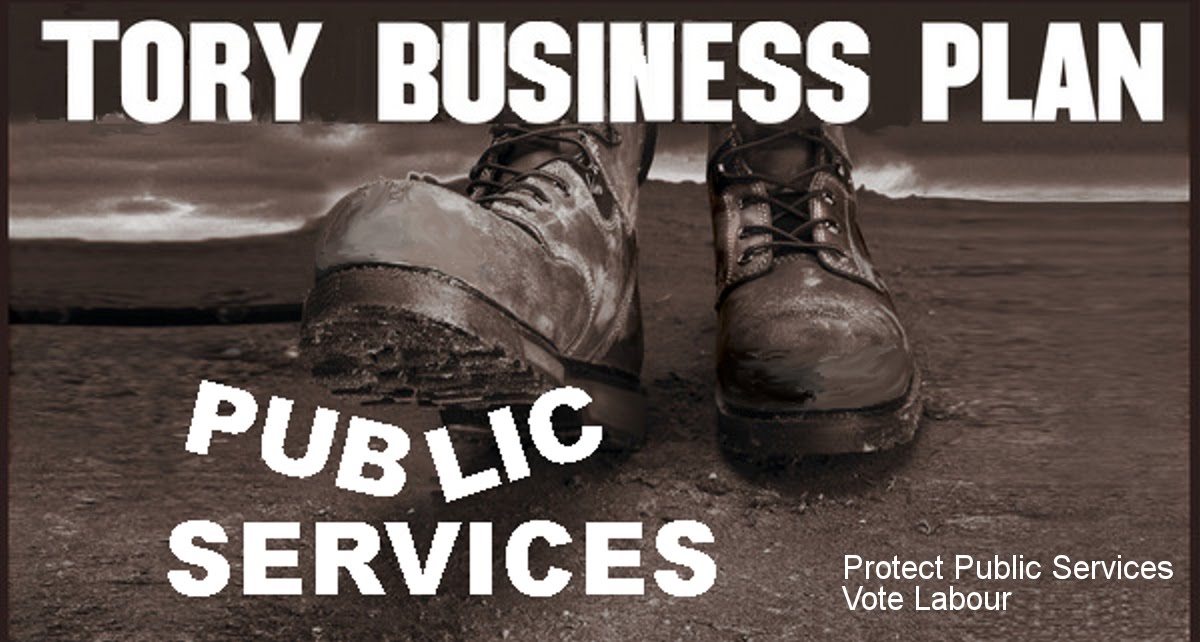
The end of public services
This election is all about public services. Who will reform and preserve our public services in the new world of smaller public spending. The answer is quite simple. If the Conservatives win then there will be no public services. Take for example this excerpt from Cameron's "Big Society" speech:
Opening up public services to new providers and saying to charities and private companies - 'if you've got the ideas and the people to tackle our most deep-rooted social problems, come and play a role in our public services.'
Let no one misunderstand what this means. Under Cameron there will be no public services, they will all be privatised. No private company will 'come and play a role' unless it can make a profit. By company law, it cannot. Company law says that private companies must be run for the benefit of the shareholders.
Yet Cameron is trying to make it seem like, out of the goodness of their hearts, they will provide services for our benefit. If a private company makes a profit, then by definition that is less money that goes into providing the service, which either means a poorer service, or poorer wages and conditions for the workers.
Oliver Letwin, Cameron’s policy chief and known as the "ideas man" of the Conservative party said this in a Wall Street Journal interview:
We will implement a very systematic and powerful change agenda where hospitals compete for patients, schools compete for pupils, welfare providers compete for results in getting people out of welfare and into work.
Do you really think that public services should be competing with itself? The competition will not be between publicly owned services but between private companies.
Unless the public snap out of the current silly "maybe we should give the other lot a chance" attitude, then 2010 will be the year that public services disappeared from this country. Wouldn't that be ironic, the year that the United States finally got universal healthcare the United Kingdom lost its.
Just a reminder for everyone. If you oppose the privatisation of public services then come on the march and rally in Trafalgar square in ten days time. www.10410demo.co.uk. I'll be there.
Opening up public services to new providers and saying to charities and private companies - 'if you've got the ideas and the people to tackle our most deep-rooted social problems, come and play a role in our public services.'
Let no one misunderstand what this means. Under Cameron there will be no public services, they will all be privatised. No private company will 'come and play a role' unless it can make a profit. By company law, it cannot. Company law says that private companies must be run for the benefit of the shareholders.
Yet Cameron is trying to make it seem like, out of the goodness of their hearts, they will provide services for our benefit. If a private company makes a profit, then by definition that is less money that goes into providing the service, which either means a poorer service, or poorer wages and conditions for the workers.
Oliver Letwin, Cameron’s policy chief and known as the "ideas man" of the Conservative party said this in a Wall Street Journal interview:
We will implement a very systematic and powerful change agenda where hospitals compete for patients, schools compete for pupils, welfare providers compete for results in getting people out of welfare and into work.
Do you really think that public services should be competing with itself? The competition will not be between publicly owned services but between private companies.
Unless the public snap out of the current silly "maybe we should give the other lot a chance" attitude, then 2010 will be the year that public services disappeared from this country. Wouldn't that be ironic, the year that the United States finally got universal healthcare the United Kingdom lost its.
Just a reminder for everyone. If you oppose the privatisation of public services then come on the march and rally in Trafalgar square in ten days time. www.10410demo.co.uk. I'll be there.
Thursday, 25 March 2010
I am a Cider Drinker*
* actually I am not, that is just a title for a blog post.
I mentioned in my analysis of the Conservative Green Paper on Public Health that they wanted to create a Department of Public Health and used behavioural economics to make us all change our behaviours to be healthy. I pulled out some of their policies including this one:
Then in this week's budget Alistair Darling did just that, he increased the tax on cider. So perhaps the Tories were right all along? Cameron certainly thought so in his response:
"Remember our tax plan for super-strength cider? When we announced it, the Chancellor's spokesman said that that was illegal. It is now official Government policy."
But then Cameron flip-flops and says:
"The Government has made a mistake. They don't understand the West Country, they don't understand this part of our country and they've got it wrong. Of course we need a higher tax on the dangerous high strength, things like White Lightning, which have as much relation to an apple as I do with Gandhi. But proper cider that people like to drink down the pub, we shouldn't be having a great tax hike on that."
Clearly the Conservatives are just that: an opposition. They oppose. That is all they do, and when the government changes its mind the Conservatives change their minds so that they still oppose the government.
Clearly the best place for the Conservatives is on the opposition benches since that is what they do best!
I mentioned in my analysis of the Conservative Green Paper on Public Health that they wanted to create a Department of Public Health and used behavioural economics to make us all change our behaviours to be healthy. I pulled out some of their policies including this one:
"We will treble duty on alcopops, we will significantly increase tax on super-strength beer and we will more than double tax on super-strength cider."I pointed out that the Conservatives say they are low tax, but they were still going to use tax as part of their "behavioural economics".
This is from a party who say that they will tax us less. This is a policy that will clearly affect moderate drinkers of these beverages.
Then in this week's budget Alistair Darling did just that, he increased the tax on cider. So perhaps the Tories were right all along? Cameron certainly thought so in his response:
"Remember our tax plan for super-strength cider? When we announced it, the Chancellor's spokesman said that that was illegal. It is now official Government policy."
But then Cameron flip-flops and says:
"The Government has made a mistake. They don't understand the West Country, they don't understand this part of our country and they've got it wrong. Of course we need a higher tax on the dangerous high strength, things like White Lightning, which have as much relation to an apple as I do with Gandhi. But proper cider that people like to drink down the pub, we shouldn't be having a great tax hike on that."
Clearly the Conservatives are just that: an opposition. They oppose. That is all they do, and when the government changes its mind the Conservatives change their minds so that they still oppose the government.
Clearly the best place for the Conservatives is on the opposition benches since that is what they do best!
Subscribe to:
Posts (Atom)


 Posts
Posts

